
By Jesse Fenty
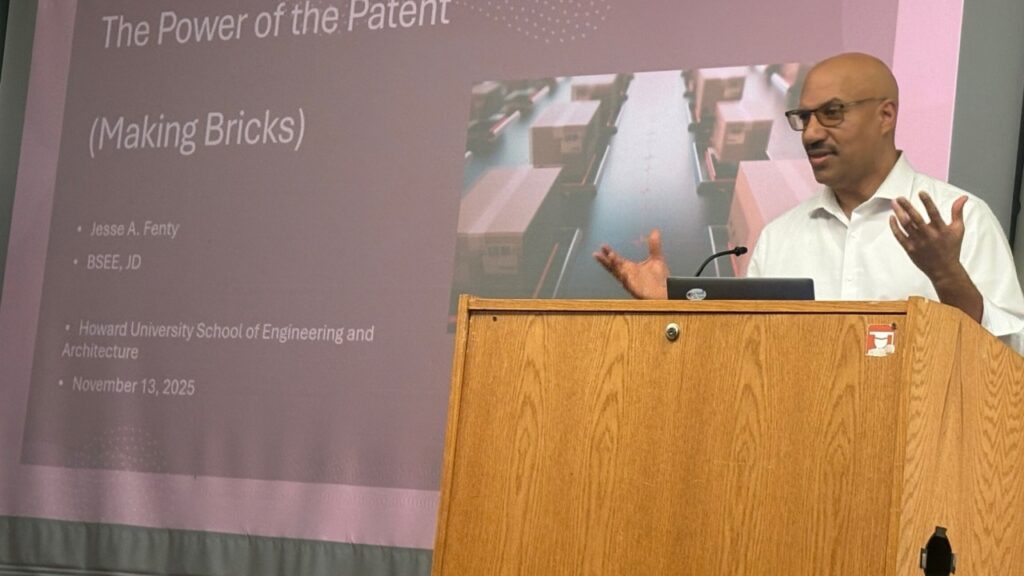
On Thursday, November 13, 2025, I had the pleasure of addressing the Intro to Networking Class at Howard University School of Engineering and Architecture. The class is being taught by my friend and former School of Engineering classmate, Dr. Torrance Fennell, who invited me to come share some Intellectual Property insights with his class.
I led off my lecture with a discussion of history, asking the class of juniors and seniors had they heard of Booker T. Washington and his book, Up From Slavery? Only one student raised their hand. I recounted one of my fundamental lessons from this book. Washington relates that he wanted to buy bricks to build buildings at his new campus in Tuskegee, Alabama. Unfortunately, the “white” townspeople would not sell him any bricks or materials. Undaunted, Washington and his team set out to make their own bricks. On their third try, and almost out of money, they succeeded in producing suitable bricks, and literally built their own school buildings. This is the essence of self-reliance.
My goal with the lecture was to inform the students that, as Engineering students, they are being given the raw materials to make inventions and obtain Patents. I explained to them aspects of Property Law and Intellectual Property Law. I discussed prolific American solo inventors such as Gary Michelson and Lonnie Johnson, as well as famous companies Amazon, Facebook, Google, Nvidia, and the like. I showed the students patent images and text, to explain that patent documents are engineering documents, material they’re familiar with. We did a nice group exercise showing how to distinguish an invention from prior art. The students asked good questions that led to further discussion of Provisional Patent applications, Trade Secrets, Inventorship, Copyright, and IP Licensing.
I closed with another historical touchstone that has shaped my career: The Mis-Education of the Negro, by Carter G. Woodson. Woodson teaches that if your degree can only be used to empower large corporations—and cannot be used to empower yourself or your community—then you have been mis-educated. That message continues to guide the work I do and the conversations I have with young engineers and businesspeople.
DISCLAIMER. We are providing this article for general informational purposes only. This does not provide legal advice.